A Day Installing a Front End with the AMG Team: The Technical Precision Powering the Observatory’s Vision
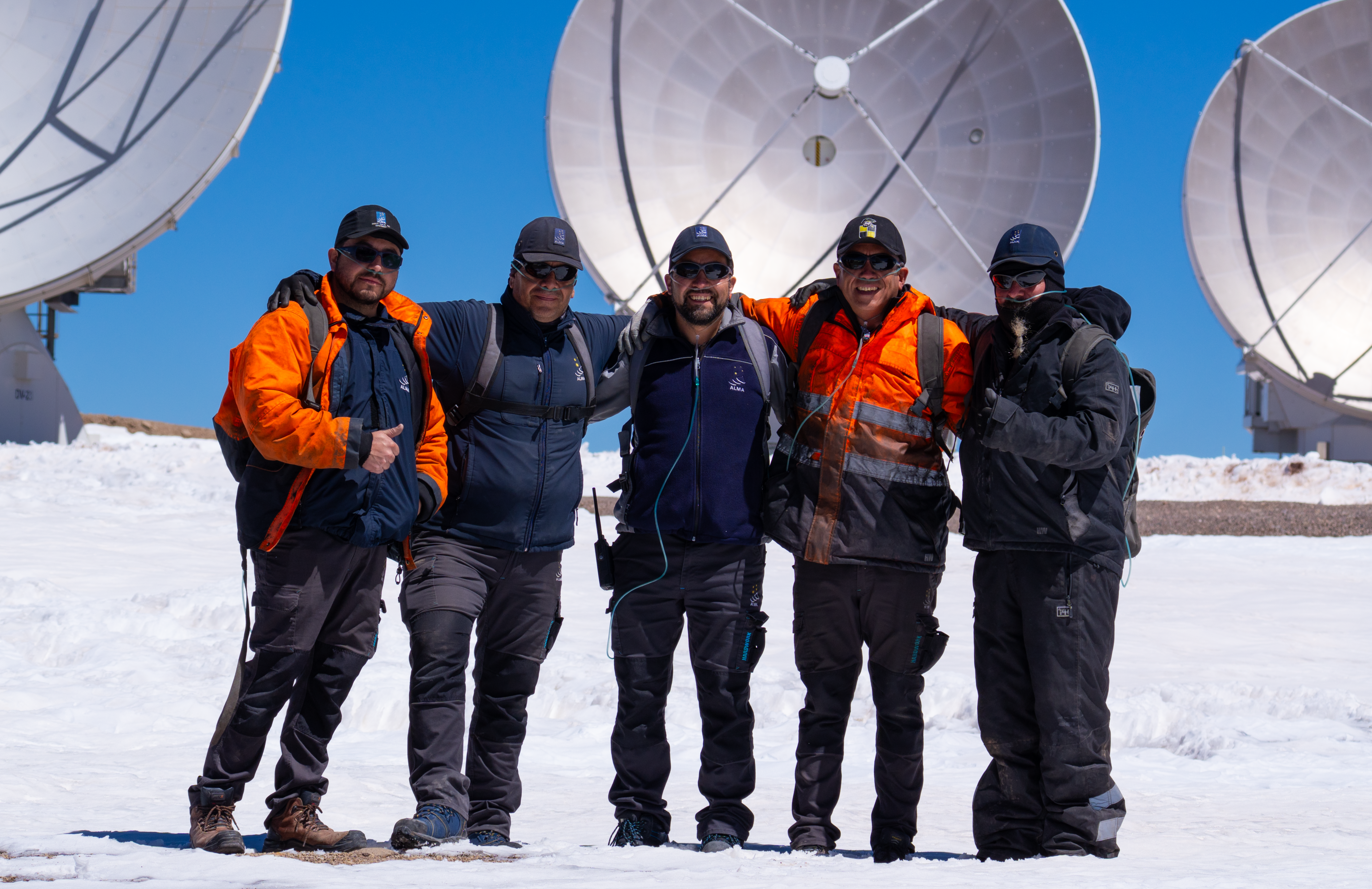
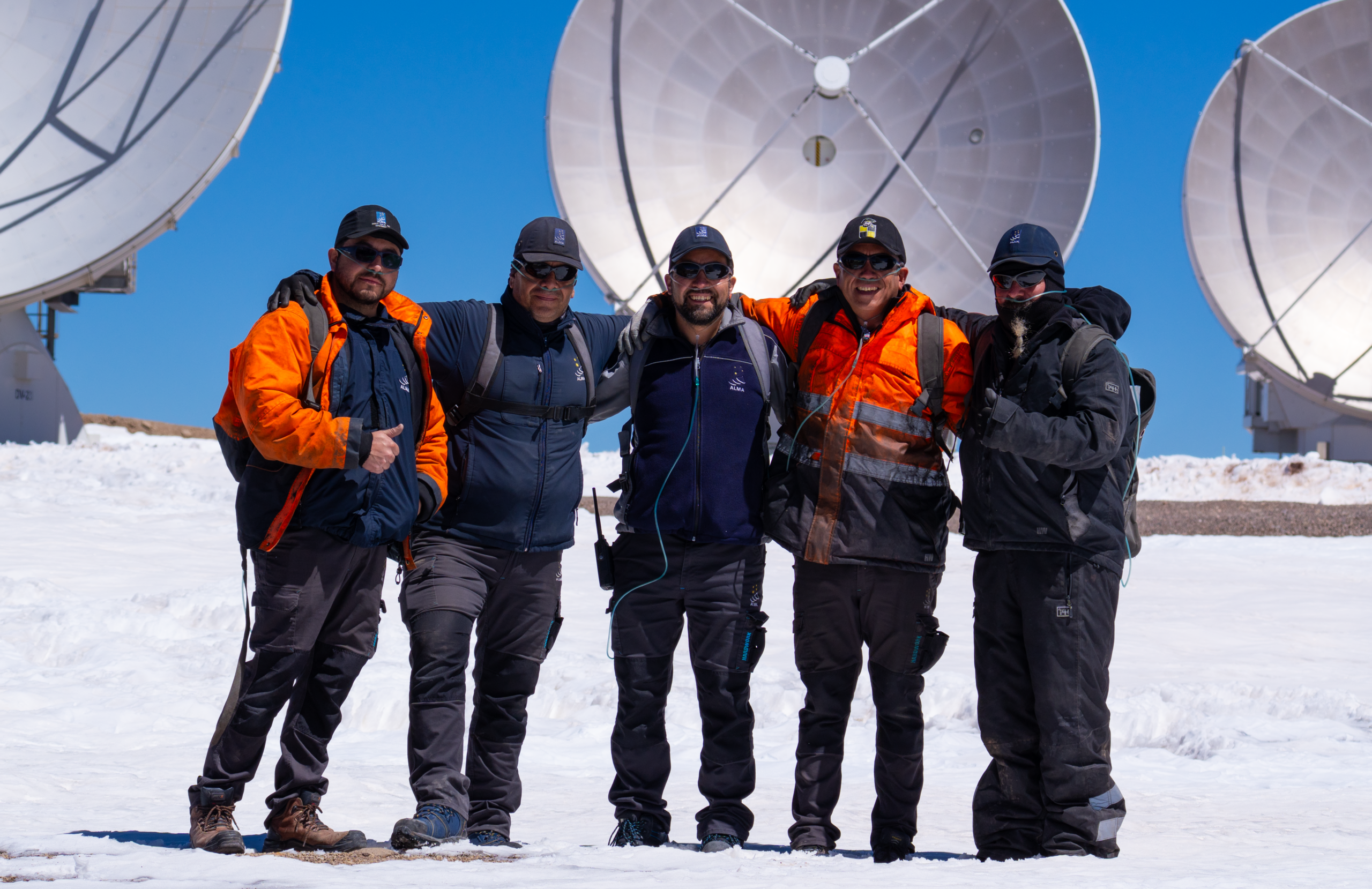
We accompanied Manuel Acevedo, Francisco Pino, Cristian Díaz, Víctor Polanco, and Juan Torres as they performed one of the most critical procedures for maintaining continuous observations.
Surrounded by snow amid the peaks of the vast Chajnantor Plateau, the Array Operations Site (AOS) awaits the start of the day’s first procedure: the Array Maintenance Group (AMG) team must install a Front End and its power supply into antenna DA-61. The operation, one of the most delicate and crucial for the observatory’s science, requires technical and human coordination across the entire group to ensure every component functions with precision, guaranteeing a safe maneuver and allowing the antenna to continue exploring the coldest reaches of the universe.
Before getting started, the team gathers to establish the estimated time for the procedure and review the safety guidelines that govern each stage of the installation. “Moving such sensitive equipment at this altitude demands high-level coordination inside the cabin. Over the years, we’ve built a dynamic where communication and safety go hand in hand. Ensuring the heart of the antenna remains spotless and ready to observe depends entirely on our coordination,” emphasizes Manuel Acevedo, Technician I.
The Transport: The Giant FESV and Reaching the Antenna
To transport heavy equipment and instruments to the AOS, the team uses the Front End Service Vehicle (FESV), a 440-horsepower truck designed specifically for this task.
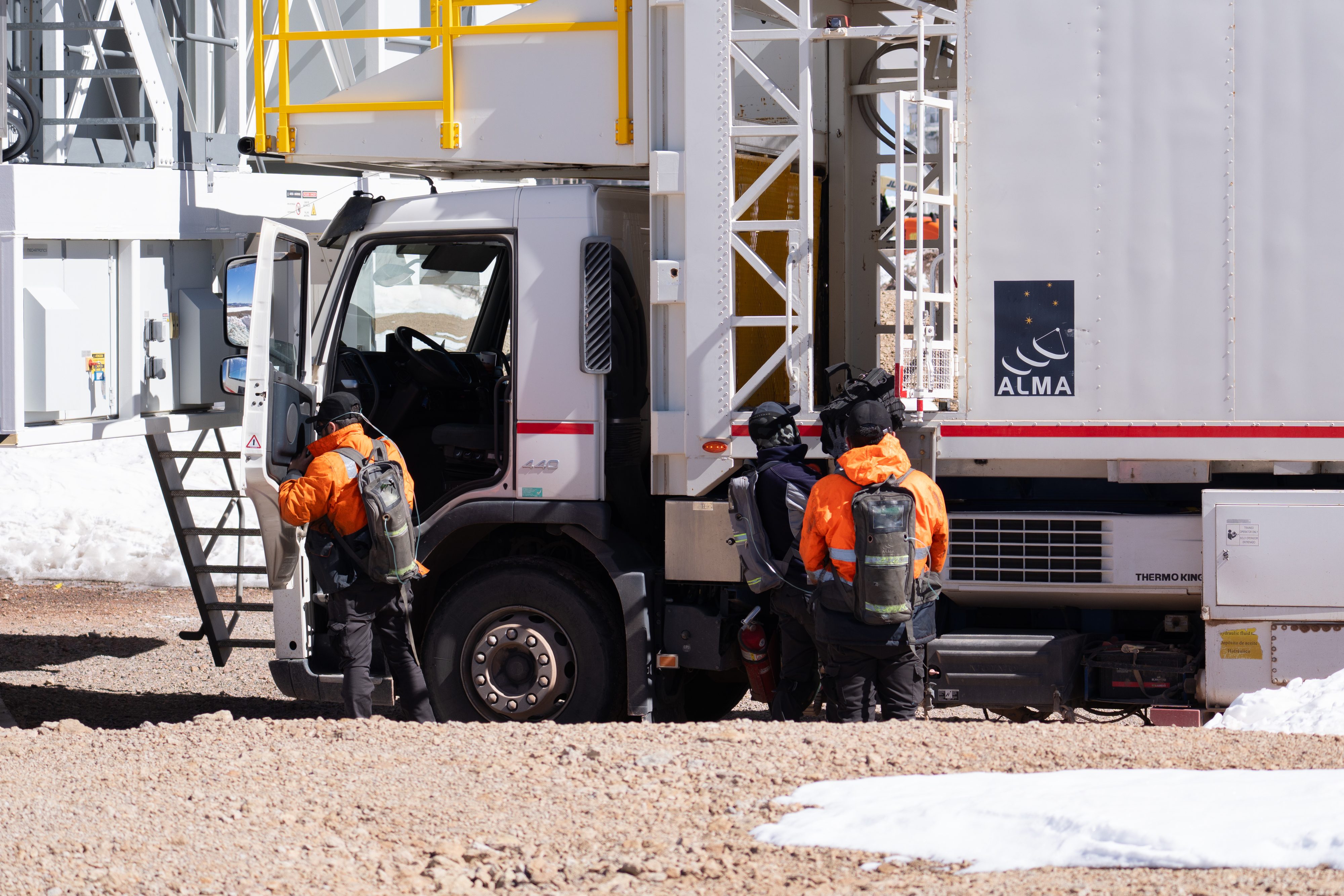
For Juan Torres, Technician II (Mechanical) and FESV operator, driving this vehicle is no ordinary job. Following storms and heavy snowfall across the AOS, Juan must navigate narrow snow-lined roads to reach the targeted antenna where the Front End installation will take place.
Upon reaching the designated antenna, the team verifies that wind speeds remain below the 15 m/s threshold. After completing the safety lockout/tagout of the drive system, the antenna is stowed into position for the maneuver. Everything is in order, ready to proceed.
A Precision Operation
Installing a Front End means moving nearly a ton of ultra-sensitive equipment inside a space with zero room for error. Weighing nearly 800 kilograms between its electronic chassis and cryostat, the assembly enters the receiver cabin flanked by its 250-kilogram power supply.
It is at this point in the operation where the team’s seamless communication becomes evident: within the antenna’s narrow internal cavity, surrounded by carbon-fiber walls, Manuel, Francisco, Cristian, Víctor, and Juan begin the installation’s most critical maneuver. A single minor bump against the structure could freeze months of operations.
The process relies on a quiet, calculated routine. Amid the metallic echo of the cabin, the team adjusts the conical support pins until hearing the exact click of the torque wrench reaching its target value.
“Inside the cabin, there is no room for improvisation. We are handling components that weigh nearly a ton just millimeters away from very fragile structures. The key isn’t just technical skill, but communication. That is what allows us to move the load safely and fit every piece into place perfectly,” explains Víctor Polanco, Technician II (Mechanical).
This critical phase demands complete synchrony. Through precise manual adjustments, shared glances, and clear communication between those guiding the load and the hoist operator, the main assembly rises slowly, inches from the Back End racks, until the Front End clicks firmly and seamlessly into its chassis. Words of encouragement and camaraderie fill the cabin. The most complex phase has been successfully completed, quickly followed by lighthearted jokes and laughter. With the guide rods secured, the team removes the protective covers, exposing the band windows: the Front End is fully docked.
Electrical Tests and the Vacuum Challenge
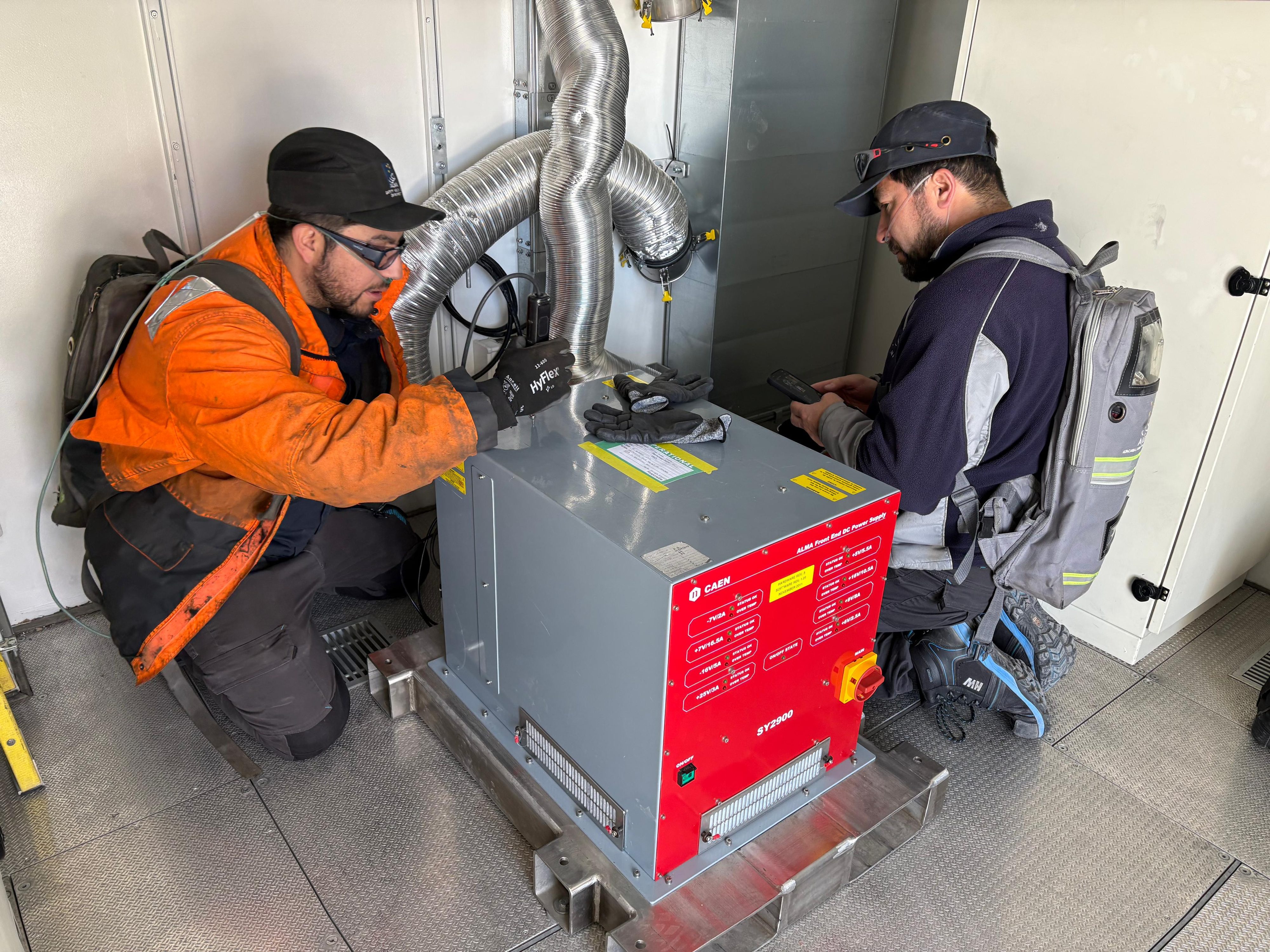
Once the Front End is docked and the power supply is secured, the electronics and cryogenics work begins. Francisco Pino, Technician I (Electronics), and Juan Torres initiate the post-assembly testing protocol:
“Once the equipment is installed, it undergoes continuity and insulation tests. The vibration from the truck during transport can cause minor faults. We inject 250 volts into the power supply to verify that all enclosures are properly grounded and that the power phases are fully insulated,” Francisco details.
After passing these electrical tests, the work continues: “Back at the technical building, cooling tests begin, which mainly involve pumping down the Front End to create a vacuum before starting the cool-down process,” he explains.
The Strength of the Group: Trust and Cross-Checking at 5,000 Meters
Every stage of the procedure highlights a defining trait of the team: mutual trust and effective communication drive the entire operation. Working at 5,000 meters above sea level imposes additional physical demands, making peer support essential.
Manuel reflects on the human element that sustains AMG’s work: “The strong relationships we have as a team build trust. Some members have been here for 10, 15, or 17 years, which makes us highly coordinated. We practice what we call cross-checking. Each person checks their colleague’s work, supporting one another step by step. We complement each other.”
For Cristian Díaz, Technician II (Mechanical), empathy and camaraderie help counter the isolation of the environment: “At this altitude, you’re isolated from everything. The challenge is building teamwork, looking out for each other, and maintaining mutual respect. Every job here matters; the Front End is the heart of the antenna, and conducting operations safely is what allows us to maintain the success of every task we carry out.”
At the end of the procedure, with the Front End installed inside the antenna, electrical tests cleared, and the cryostat ready for vacuum pumping, the team packs up their tools. Back in the truck, they prepare to return to the AOS Technical Building. Outside, the wind still blows, though slightly gentler than in the morning. As they navigate the snow-lined roads among the antennas and white peaks dressing the Chajnantor Plateau, there is a shared sense of satisfaction: the certainty that, through their coordination and precision, ALMA will continue exploring the deepest corners of the universe.